


 | ||
|
| ||


Hook & Loop
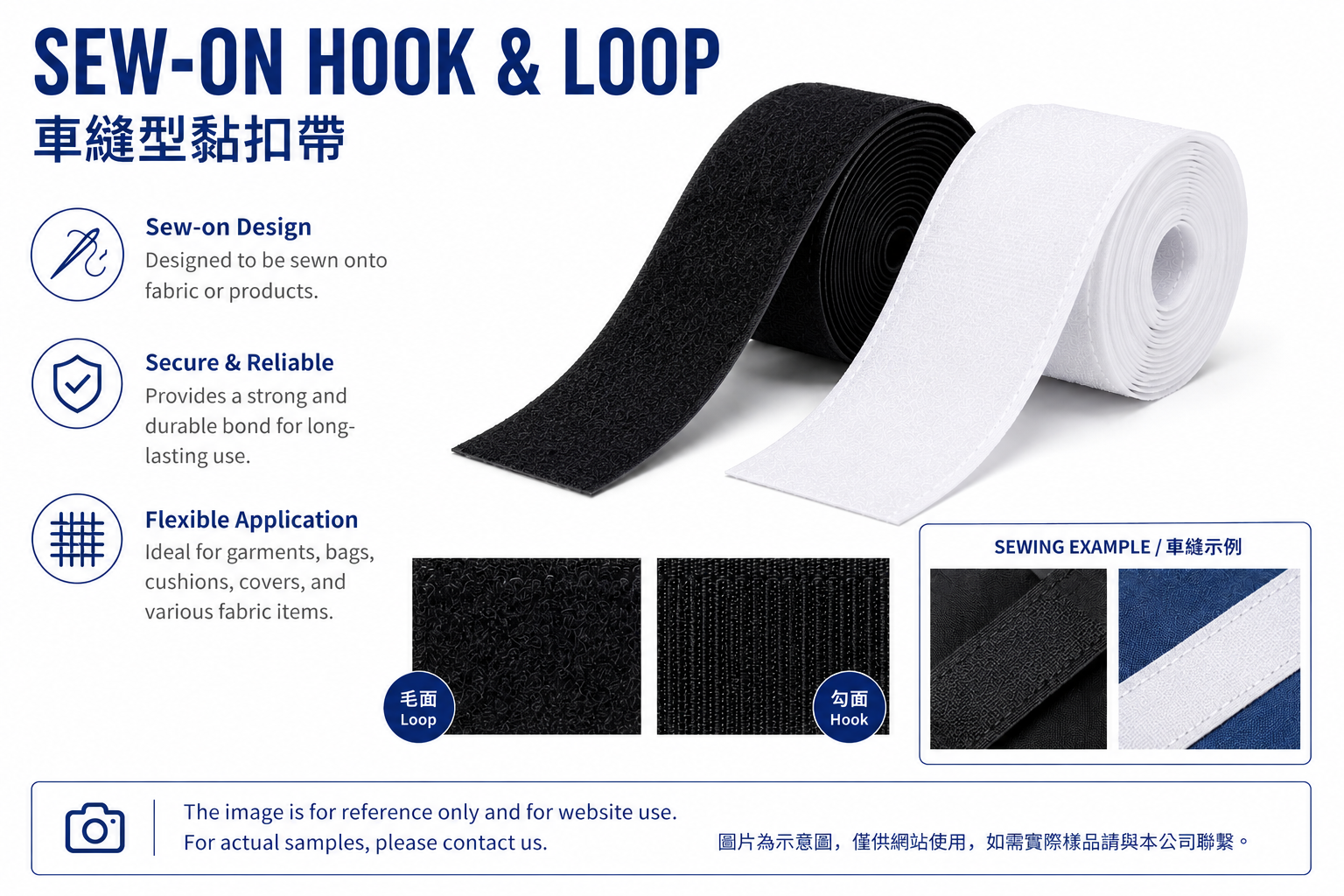
Product Name : Sew-on Hook & Loop
| Description |
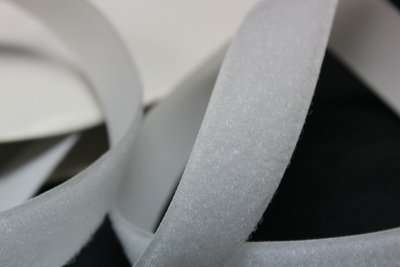
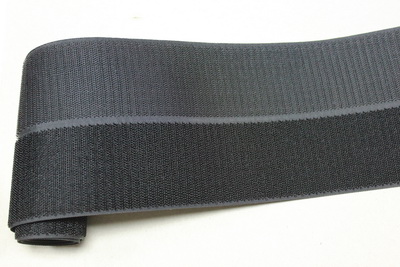
| Sew-On Hook & Loop Tape is a non-adhesive mechanical fastening material designed to be secured to fabrics, webbing, footwear materials, bags, and other sewable substrates by stitching. The Hook and Loop surfaces engage to create a reusable opening and closing system. Its main difference from adhesive-backed Hook & Loop is not the fastening mechanism itself, but the way the tape is attached and integrated into the finished textile product. Finished performance depends on more than Hook-to-Loop engagement alone. Substrate thickness, flexibility, stitch position, edge structure, sewing layout, and load direction can all affect how the tape performs after installation. Peel and shear values describe the closure between the Hook and Loop surfaces, while the strength of the tape after sewing onto a substrate is a separate structural consideration. A suitable sewing layout is therefore important to avoid localized stress or premature failure around the attachment area. In production, Sew-On Hook & Loop Tape is often converted through cutting, Hook / Loop pairing, positioning, sewing, and other secondary processes before being integrated into garments, bags, footwear, protective products, webbing assemblies, or other textile applications. Fu Jyi Lin can support project-specific development by evaluating the Hook / Loop configuration, cutting format, sewing method, and final integration according to the substrate, dimensions, and finished-product requirements. |
 Features
 |
||
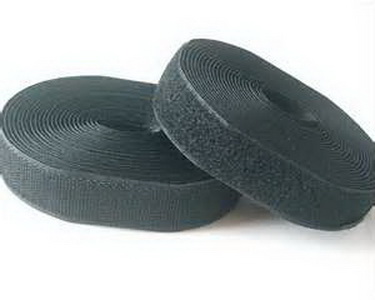
Sew-on Hook & Loop |
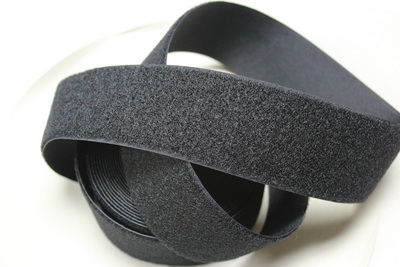
Sew-on Hook & Loop |
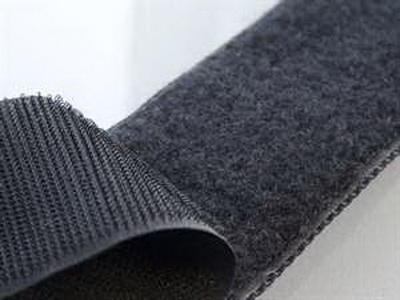
Sew-on Hook & Loop |
Sew-on Hook & Loop |
Sew-on Hook & Loop |
|
Specification |
|
**1. Product Name** "Sew-On Hook & Loop Tape", designed with a non-adhesive backing and primarily secured to textiles, webbing, footwear materials, bags, and other sewable substrates by stitching or sewing. **2. Construction / Attachment Method** The product uses a mechanical fastening system consisting of **Hook and Loop surfaces** rather than a pressure-sensitive adhesive backing. Final attachment should be made by sewing or another suitable fixing method according to the substrate, product construction, and expected load conditions. **3. Hook / Loop Configuration** Available as **Hook only, Loop only, or Hook + Loop matched pairs**. Closure performance depends on the selected Hook and Loop construction, material, and mating combination; therefore, production should follow the approved pairing specification. **4. Material / Tape Construction / Width** Available materials may include **Nylon / Polyamide, Polyester, and Nylon / Polyester blends** with woven Hook / Loop constructions. **Standard width range: 16–50 mm; custom width range: 60–110 mm.** Final availability should be confirmed according to material, Hook / Loop construction, order quantity, and production conditions. **5. Colors / Custom Color Matching** Black, white, standard colors, and custom colors can be developed according to **Pantone references, physical color samples, or approved samples**. Reasonable color variation may occur depending on material, dye lot, Hook / Loop construction, and processing conditions. **6. Roll Length / Supply Format** Products can be supplied in roll form, with Hook and Loop packed separately or supplied according to the required mating configuration. Common market-reference roll lengths may include **25 m and 50 m per roll**, while final roll length and supply format should follow production and order requirements. **7. Sewing Edge / Cutting & Conversion** Woven selvedge, cut lengths, paired cutting, specified dimensions, and other conversion options can be **evaluated according to actual product requirements and production conditions**. Different widths, materials, and Hook / Loop constructions may require different cutting or conversion settings. **8. Closure Performance / Test Verification** Key closure-performance parameters may include **Peel Strength, Shear Strength, and opening/closing cycle performance**. Actual results depend on Hook / Loop material, construction, mating combination, loading direction, and test conditions. Performance should therefore be verified using the approved product and agreed test method rather than treated as a universal fixed specification. **9. Packing / MOQ** Packing and MOQ depend on **material, width, color, Hook / Loop configuration, roll length, cutting or conversion format, custom color requirements, and order quantity**. Special widths, multiple colors, or project-specific processing may require different production minimums. **Specification Notes** Sew-On Hook & Loop Tape uses a non-adhesive Hook / Loop construction and is primarily secured to suitable substrates by sewing. Material, width, Hook / Loop structure, sewing-edge design, and substrate conditions can influence the attachment method and finished-product performance. Peel strength, shear strength, and cycle performance describe the Hook-to-Loop closure, while the strength of the tape after sewing onto a substrate is a separate performance consideration. Where closure, stitch-tear, washability, durability, or other defined requirements apply, the product construction, test method, conditions, and acceptance criteria should be confirmed before verification. Mass production should be based on the approved sample, confirmed material, Hook / Loop configuration, width, color, roll length, cutting or conversion format, testing requirements, packing specifications, and other mutually agreed production conditions. Fu Jyi Lin reserves the right to adjust product specifications according to product improvements, process optimization, or customer requirements without prior notice. |
|
Asks Description |
|
Frequently Asked Questions (FAQ) 1. What fabrics can the Hook surface accidentally snag? The Hook surface may catch more easily on textiles with loops, raised fibers, brushed surfaces, open structures, or loose yarns, such as certain knits, terry fabrics, fleece, brushed textiles, mesh, lace, or loosely constructed fabrics. Actual snagging depends on the Hook design, textile surface, and contact conditions. 2. How can unintended snagging or fabric damage be reduced? Product design should consider Hook orientation, exposed Hook area, edge position, sewing location, and surrounding textile structure. Where delicate or loosely constructed fabrics are used nearby, direct rubbing against the Hook surface should be minimized. Protective overlap, placement adjustment, or a softer Hook construction may also be evaluated where appropriate. 3. Can lint, fibers, or debris reduce Hook & Loop performance? Yes. Lint, loose fibers, threads, dust, or other debris can occupy the Hook structure and reduce effective engagement with the Loop surface. This may gradually change closure feel, peel performance, or shear behavior. Keeping the Hook surface reasonably clean can help maintain more consistent engagement. 4. Why do different Hook and Loop combinations produce different closure performance? Closure behavior depends on the Hook shape, height, density, Loop structure, pile density, material, and mating combination. Different pairings can therefore produce different peel strength, shear strength, opening force, and cycle behavior. Hook and Loop components should be evaluated as a matched system rather than as separate parts. 5. How can repeated use, abrasion, or washing affect closure performance? Repeated cycling, surface abrasion, lint accumulation, washing, drying, heat, and detergents may affect Hook geometry, Loop condition, appearance, and closure performance. Where cycle life, washability, abrasion resistance, or durability is specified, the selected product construction should be verified under agreed test methods and acceptance criteria. |
 |
Fu Jyi Lin Enterprise Co., Ltd. Copyright © 2014 |
| Address: 10071 No.17-1, SHAU ANN St., Zhongzheng Dist., Taipei City 100, Taiwan (R.O.C.)
TEL:886-2-2301-5900 , 886-2-2307-0952 FAX:886-2-2307-5424 , 886-2-2332-6930 E-Mail:info@fujyilin.com.tw |