


 | ||
|
| ||
News |


|
| Combining Webbing, Elastic and Hook-and-Loop for Wearable and Rehab Devices | |
2026-10-15 15:06:27 | |
**Webbing, Elastic and Hook-and-Loop: Combining Strap Materials for Wearable and Rehabilitation Devices**
As MEDICA 2026 approaches, wearable healthcare and rehabilitation technology provide a useful context for examining a practical product-design question: how should a device attach to the body?
For equipment worn around the shoulders, chest, waist, or legs, strap design involves more than selecting a material and cutting it to length. Different sections may need to hold a device in position, accommodate movement, or allow repeated adjustment. Webbing, elastic, and hook-and-loop each serve a different purpose—and can be combined within one strap assembly.
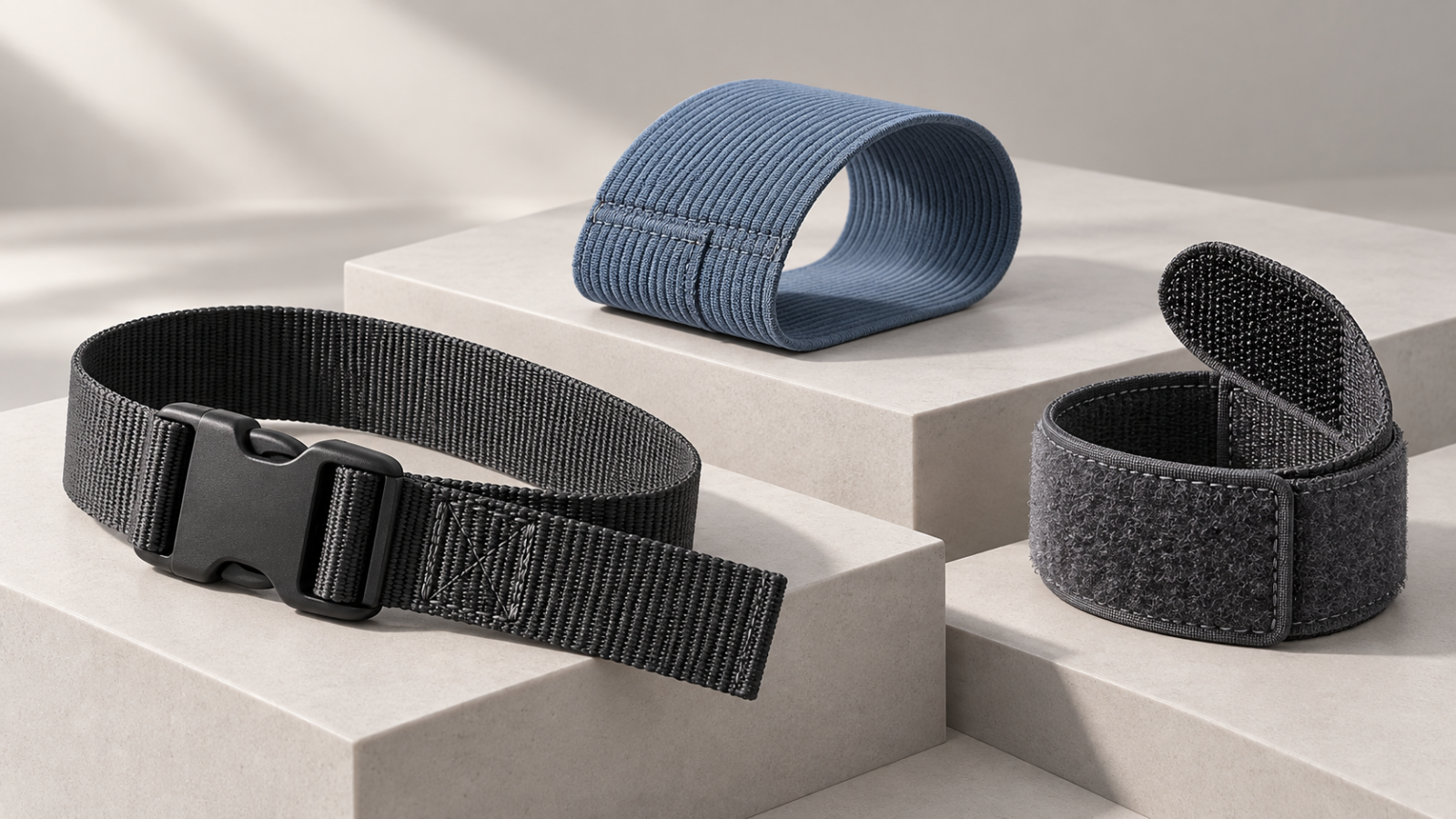
**Webbing for Structure and Hardware Attachment**
Low-stretch webbing is a useful starting point where a strap needs to maintain its adjusted length and connect to buckles, adjusters, or equipment attachment points.
Depending on the design, it can form the main section of a waist belt, shoulder strap, or leg strap. Nylon and polyester are material options to evaluate, with width, thickness, weave, and surface feel selected for the application.
Hardware compatibility also matters. Webbing should pass through the selected adjuster correctly and hold as intended. A thicker or stiffer construction is not automatically the better choice; the complete combination needs to be assessed.
**Elastic for Controlled Flexibility**
Elastic can be considered where a strap needs to accommodate body movement or changes in circumference during use. It may be used as a flexible section within an assembly rather than throughout the entire strap.
For example, a design may combine a low-stretch webbing section for adjustment with a short elastic section for movement. The appropriate balance depends on how much movement the device can tolerate while remaining correctly positioned.
Useful specifications include force at a defined extension, recovery after repeated stretching, and performance after the intended cleaning process. Excessive stretch can allow unwanted device movement, so flexibility should be matched to the application.
**Hook-and-Loop for Adjustable Closure**
Hook-and-loop can provide an adjustable closure that users open and refasten. It may be sewn onto webbing, elastic, or a textile cuff, depending on the construction.
Design considerations include the available overlap, fastening direction, opening force, and accessibility when the device is worn. Where the strap contacts the body, exposed hook edges and seam placement also deserve attention.
When hook-and-loop is attached to elastic, the stitching and closure arrangement should be evaluated together so that the assembly retains the intended stretch.
**Combining the Materials Around the Application**
There is no single combination for every wearable device. Possible arrangements for development include:
- **Waist or leg assemblies:** Low-stretch webbing with a buckle or adjuster, combined with a hook-and-loop closure where the design requires it.
- **Chest or limb sensor straps:** A controlled-stretch section with an adjustable closure, evaluated for both comfort and sensor positioning.
- **Rehabilitation cuffs:** A textile contact section with hook-and-loop closure and webbing reinforcement at selected attachment points.
These are starting points for sampling. Final material selection and construction should follow the device’s intended use and validation requirements.
**Developing Custom Strap Assemblies with Fujyilin**
Fujyilin supplies webbing, elastic, and hook-and-loop materials, with custom cutting, printing, silicone grip application, and sewing services available for evaluation according to the project.
To begin development, share the attachment position, strap dimensions, adjustment range, hardware details, estimated quantities, and testing requirements. Drawings or existing samples can help define how the components should work together.
Fujyilin can support material selection and sample development, followed by production based on approved specifications.
MEDICA 2026 takes place November 16–19 in Düsseldorf, Germany.
[Explore MEDICA 2026](https://www.medica-tradefair.com/)
|
 |
Fu Jyi Lin Enterprise Co., Ltd. Copyright © 2014 |
| Address: 10071 No.17-1, SHAU ANN St., Zhongzheng Dist., Taipei City 100, Taiwan (R.O.C.)
TEL:886-2-2301-5900 , 886-2-2307-0952 FAX:886-2-2307-5424 , 886-2-2332-6930 E-Mail:info@fujyilin.com.tw |