Industry Insight for Automotive Seat Manufacturers, Interior Suppliers, Industrial Sewing Factories, and OEM Textile Manufacturers
The automotive textile industry has evolved far beyond traditional fabric production. Today's vehicle interiors demand lightweight construction, long-term durability, precise sewing quality, and consistent manufacturing performance across increasingly complex textile assemblies. Whether producing automotive seat covers, interior trim components, headliners, armrests, or other upholstered interior parts, manufacturers are expected to maintain high production efficiency while meeting strict quality requirements.
For companies operating within the automotive textile supply chain—including Automotive Seat Manufacturers, Automotive Interior Suppliers, Automotive Trim Suppliers, Seat Cover Manufacturers, Industrial Sewing Factories, Contract Sewing Manufacturers, and OEM Textile Producers—selecting the appropriate reinforcement material has become an essential part of product development rather than a simple purchasing decision.
Unlike conventional reinforcement materials that primarily focus on structural support, today's manufacturers require reinforcement solutions capable of improving sewing stability, maintaining dimensional consistency, and supporting automated production environments without adding unnecessary weight or affecting fabric flexibility.
As vehicle interiors continue to incorporate lightweight fabrics, laminated textiles, engineered composites, recycled materials, and performance fabrics, reinforcement components must adapt to increasingly demanding manufacturing processes. Materials that perform well during prototype development may not always deliver the same consistency during continuous high-volume production. This makes reinforcement selection an important factor in reducing manufacturing risks and improving overall production efficiency.
For manufacturers supplying automotive interior systems, consistency is often more valuable than simply choosing the lowest material cost. Production interruptions caused by unstable reinforcement materials can result in sewing defects, material waste, additional inspections, and unexpected production delays. As production volumes increase, even small variations in sewing performance may significantly affect manufacturing efficiency and product quality.
This growing emphasis on manufacturing consistency explains why many industrial sewing companies are reviewing every component used throughout their production process—including reinforcement tapes that traditionally received little attention during material selection.
Among these solutions, Woolly Nylon Spin Tape has become increasingly recognized as a reliable reinforcement material for manufacturers seeking improved sewing performance, dimensional stability, and production consistency across various automotive textile and industrial sewing applications.
Industry Summary
Modern automotive textile manufacturing increasingly depends on reinforcement materials that improve sewing consistency, production efficiency, and long-term product reliability rather than simply adding structural support.
The Manufacturing Challenges Facing Today's Automotive Textile Supply Chain
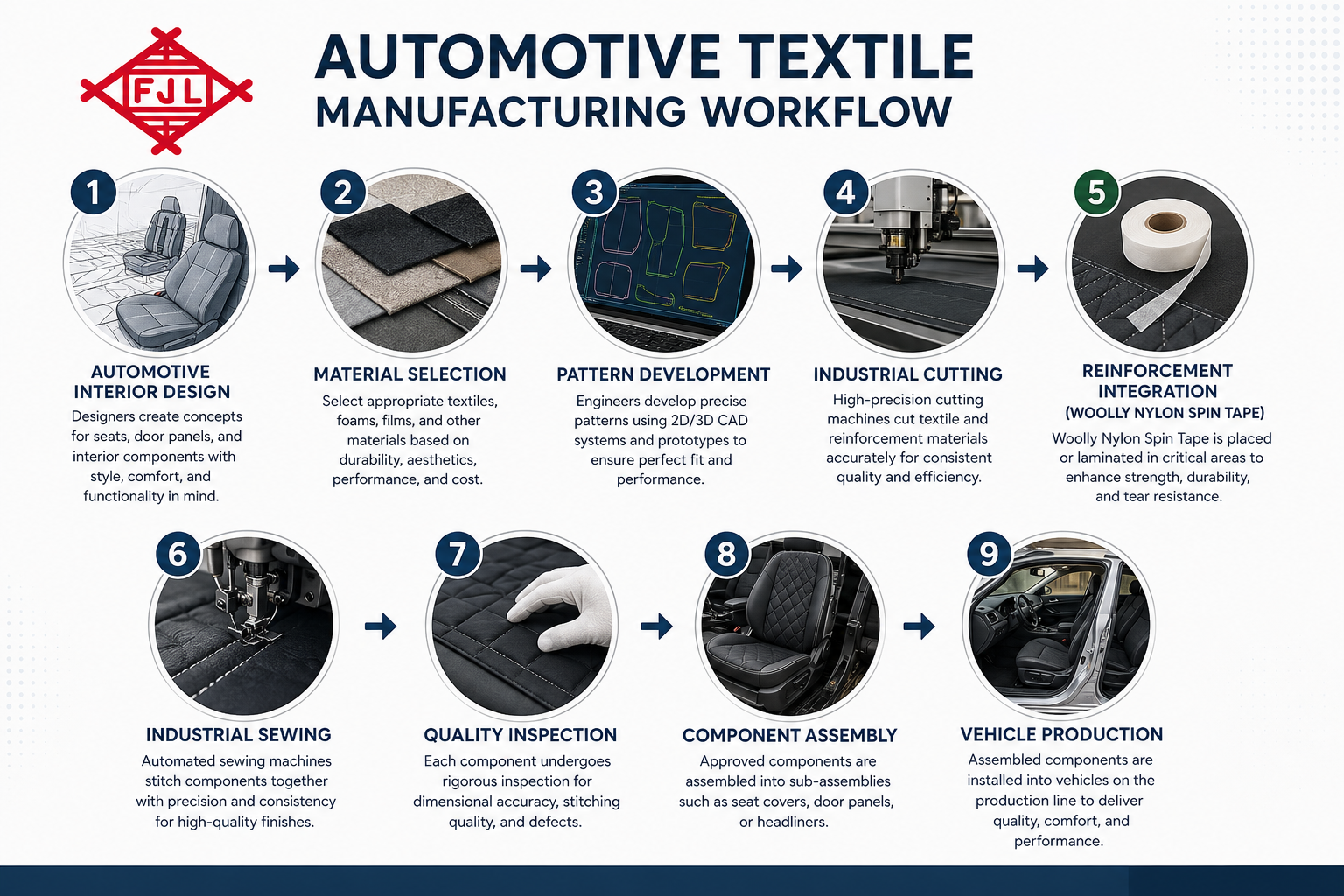
The automotive textile supply chain operates under significantly different production requirements compared with conventional apparel manufacturing. Products are expected to perform consistently throughout years of daily use while maintaining appearance, comfort, dimensional stability, and manufacturing precision.
Automotive seating systems alone involve multiple textile layers—including face fabrics, foam laminations, backing materials, reinforcement components, and decorative stitching—that must function together throughout repeated use. During manufacturing, these materials pass through multiple cutting, sewing, assembly, and inspection stages where dimensional accuracy and seam consistency directly influence final product quality.
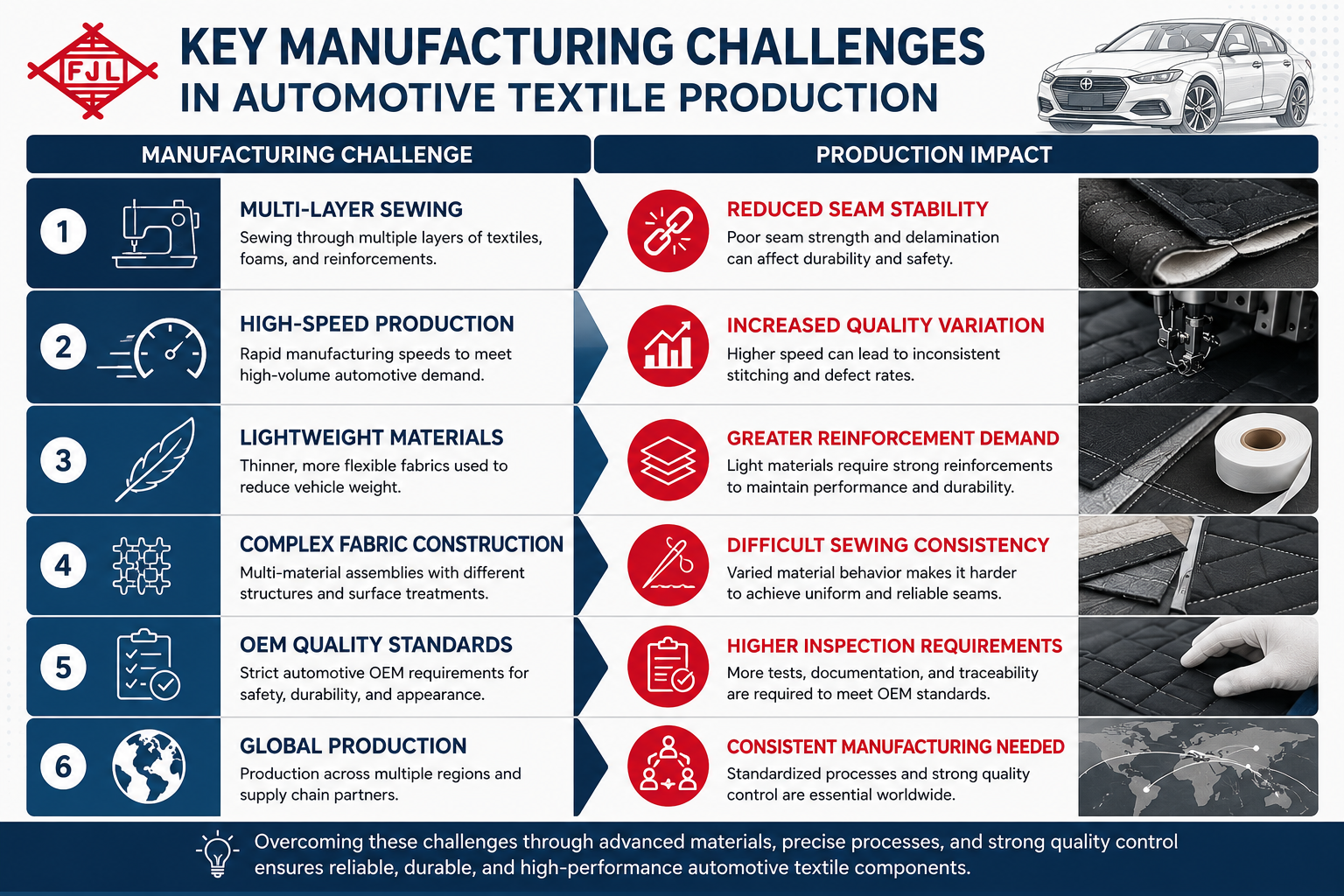
For industrial sewing factories, maintaining consistent seam performance becomes increasingly challenging as production speeds continue to increase. Automated sewing equipment requires reinforcement materials capable of moving smoothly through production lines without causing distortion, excessive tension, or irregular stitch formation. Even minor inconsistencies may result in production interruptions, additional quality inspections, or increased material waste.
Automotive Interior Suppliers also face growing expectations from OEM customers regarding manufacturing repeatability. As vehicle platforms become more standardized globally, suppliers must deliver identical product quality across multiple production batches, manufacturing locations, and international markets. Reinforcement materials therefore play a supporting—but highly important—role in maintaining production consistency.
Seat Cover Manufacturers encounter similar challenges when combining stretch fabrics, laminated constructions, decorative stitching, and complex sewing patterns. Reinforcement materials must provide adequate stability while preserving the flexibility required for ergonomic seating comfort and accurate installation during vehicle assembly.
These manufacturing realities have shifted purchasing priorities. Rather than evaluating reinforcement materials based solely on cost, many procurement teams now focus on long-term manufacturing efficiency, sewing compatibility, production stability, and consistent quality across large-scale OEM production programs.
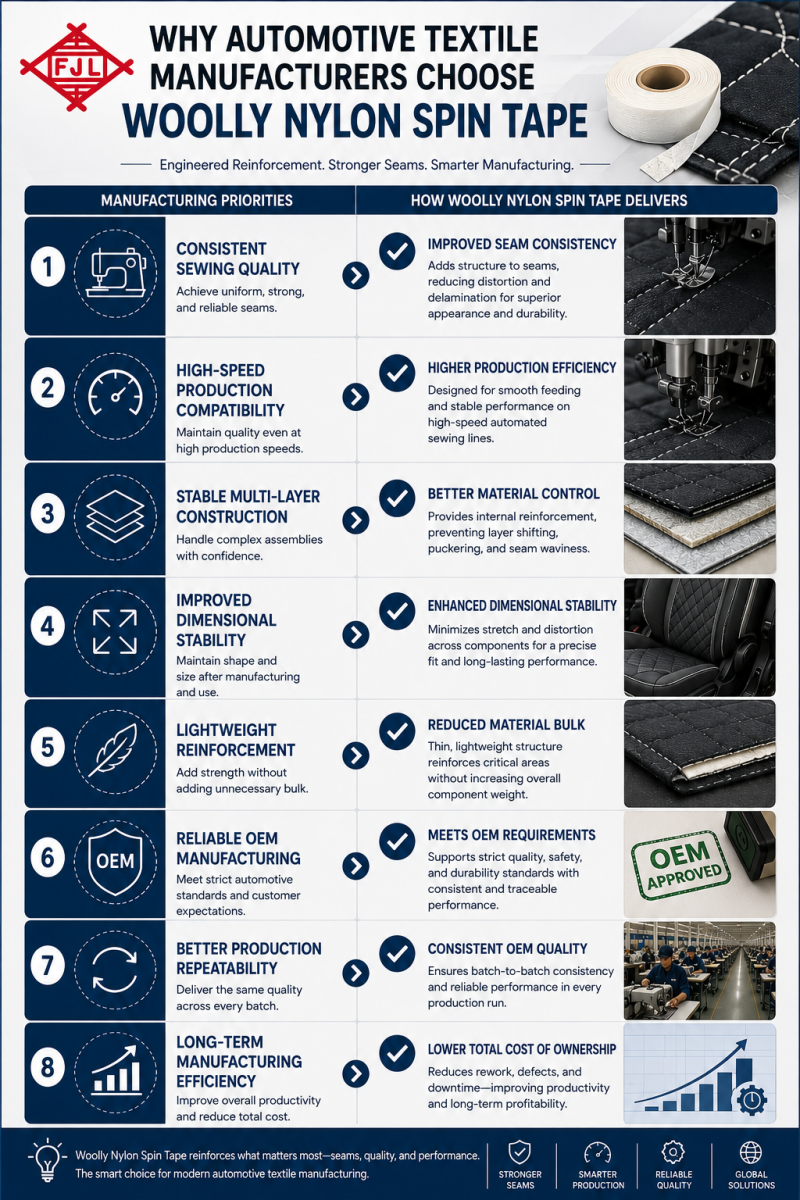
This shift has contributed to the increasing adoption of specialized reinforcement solutions such as Woolly Nylon Spin Tape, particularly among manufacturers seeking to optimize sewing performance without compromising flexibility or production speed.
Why Industrial Sewing Manufacturers Are Choosing Woolly Nylon Spin Tape
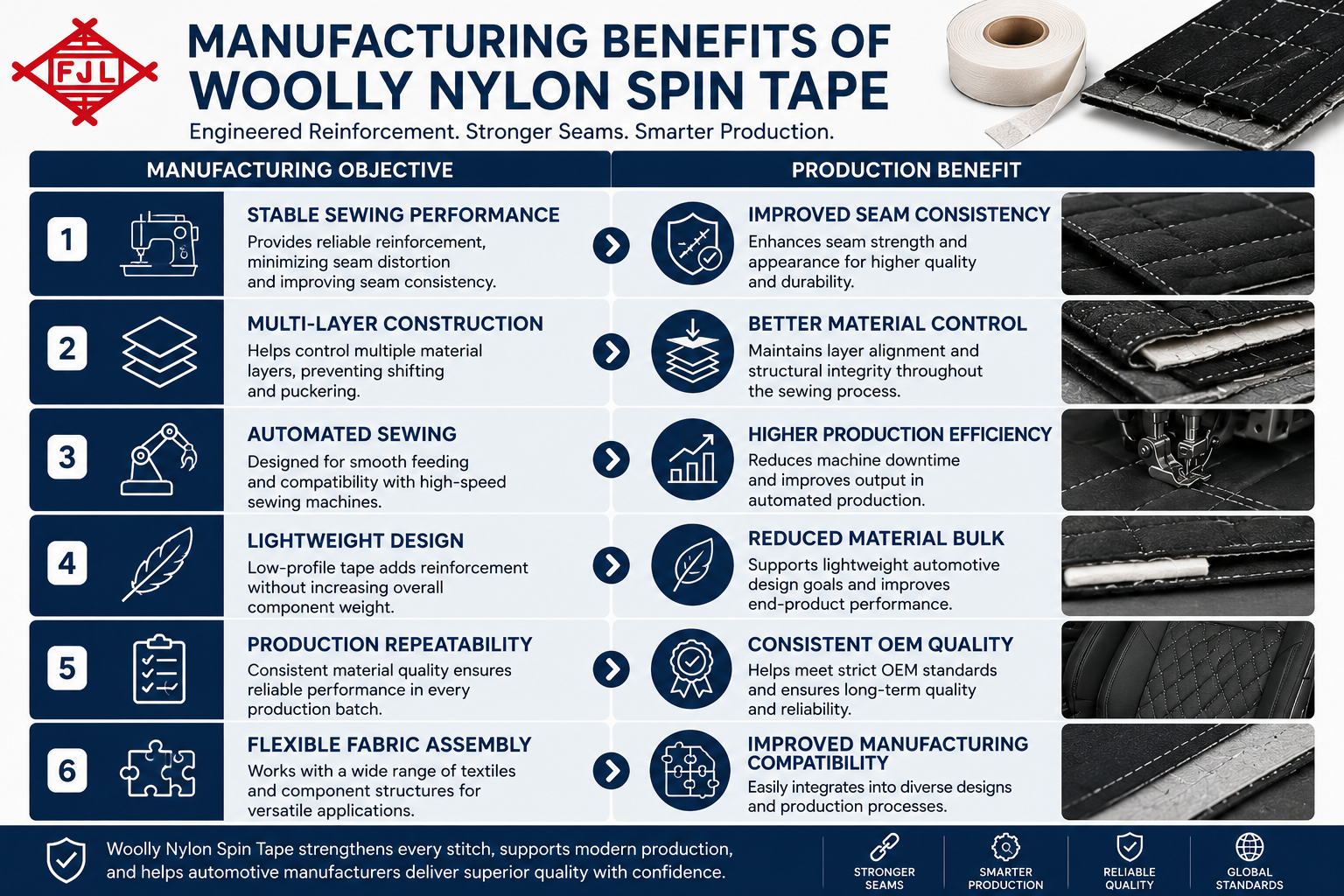
Modern industrial sewing is no longer evaluated solely by sewing speed or production capacity. Manufacturers are increasingly measured by production consistency, material compatibility, quality repeatability, and long-term product reliability. For companies supplying automotive seating systems and interior textile components, reinforcement materials have become an important contributor to manufacturing performance rather than simply an accessory within the sewing process.
Unlike conventional reinforcement materials that primarily provide additional support, Woolly Nylon Spin Tape is increasingly selected because it helps manufacturers maintain consistent sewing performance throughout different production stages. This is particularly valuable when working with lightweight textiles, laminated constructions, stretch materials, or multi-layer fabric assemblies commonly found in modern automotive interiors.
Rather than focusing only on material specifications, procurement engineers and production managers increasingly evaluate how reinforcement materials influence the overall manufacturing process—from prototype development and sewing trials to high-volume OEM production.
Improving Sewing Stability Throughout High-Volume Production
One of the primary concerns in industrial sewing is maintaining seam consistency during continuous production. Modern automotive interior components often require long production runs where even minor variations can affect dimensional accuracy, stitch appearance, and overall manufacturing efficiency.
As production speeds increase, reinforcement materials must remain stable while passing through automated sewing equipment. Materials that shift, wrinkle, or distort during sewing may interrupt production flow and require additional quality inspections or rework.
For Industrial Sewing Factories and Contract Sewing Manufacturers, maintaining stable sewing conditions helps reduce production variation while improving operational efficiency. A reinforcement solution that performs consistently under different sewing conditions contributes to smoother production and more predictable manufacturing results.
Instead of viewing reinforcement materials as a simple sewing accessory, many manufacturers now consider them part of an integrated production strategy designed to minimize variability across large manufacturing programs.
Supporting Multi-layer Automotive Textile Construction
Automotive interior products rarely consist of a single fabric layer. Seat covers, door trim panels, armrests, headrests, center console covers, and other upholstered components typically combine multiple materials, including decorative fabrics, foam laminations, backing textiles, adhesive layers, and reinforcement materials.
Each additional layer introduces new sewing challenges.
Variations in thickness, flexibility, and material movement can affect stitch quality, seam alignment, and dimensional consistency throughout production. Reinforcement materials therefore play an important supporting role by helping stabilize textile assemblies during sewing without significantly increasing bulk or reducing flexibility.
For Automotive Seat Manufacturers and Automotive Interior Suppliers, maintaining consistent sewing quality across complex textile constructions is essential to meeting OEM quality expectations. Stable reinforcement contributes to more reliable production while supporting efficient assembly across different manufacturing environments.
Reducing Manufacturing Variation Across Global Production
Automotive production increasingly operates across multiple manufacturing facilities and international supply chains. Components produced in different countries must meet identical engineering specifications while maintaining consistent appearance and performance.
This places additional demands on reinforcement materials.
Production teams are expected to achieve repeatable sewing performance regardless of production location, operator experience, or equipment differences. Materials that perform inconsistently may introduce unnecessary production risks, particularly during large-scale manufacturing programs.
Because reinforcement materials influence seam stability and fabric behavior throughout the sewing process, many procurement teams evaluate them as part of broader manufacturing risk management rather than as a simple consumable material.
This approach reflects a growing industry focus on production consistency instead of short-term material cost alone.
Enhancing Manufacturing Efficiency Without Increasing Complexity
Manufacturers continuously seek opportunities to improve productivity without adding unnecessary process complexity.
Introducing additional production steps may increase labor requirements, inspection time, or operational costs. Therefore, reinforcement solutions that integrate naturally into existing sewing operations are generally preferred over alternatives requiring significant production adjustments.
For Industrial Sewing Factories handling multiple customer programs, production flexibility is equally important. Reinforcement materials should support different fabric constructions, sewing methods, and product designs while maintaining consistent manufacturing performance.
This flexibility allows manufacturers to respond more efficiently to changing customer requirements without extensive production modifications.
Supporting Engineering Collaboration During Product Development
Selecting a reinforcement material is rarely an isolated purchasing decision.
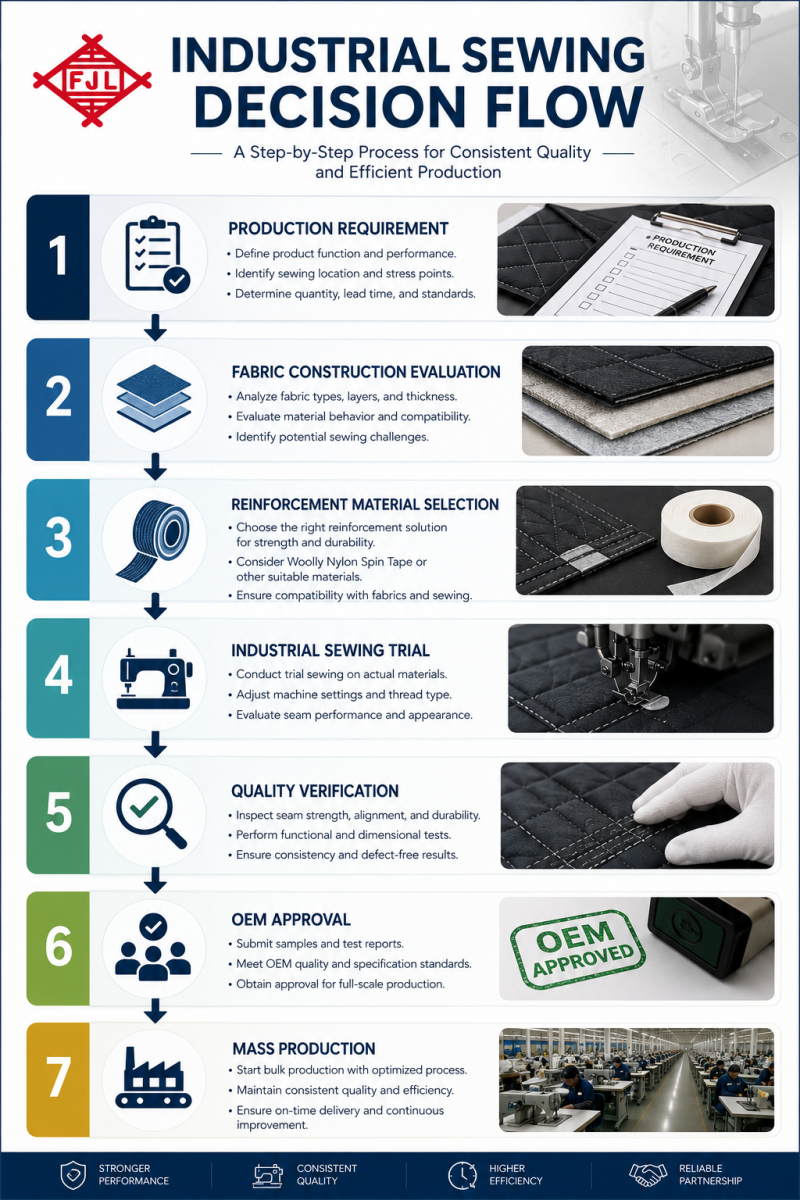
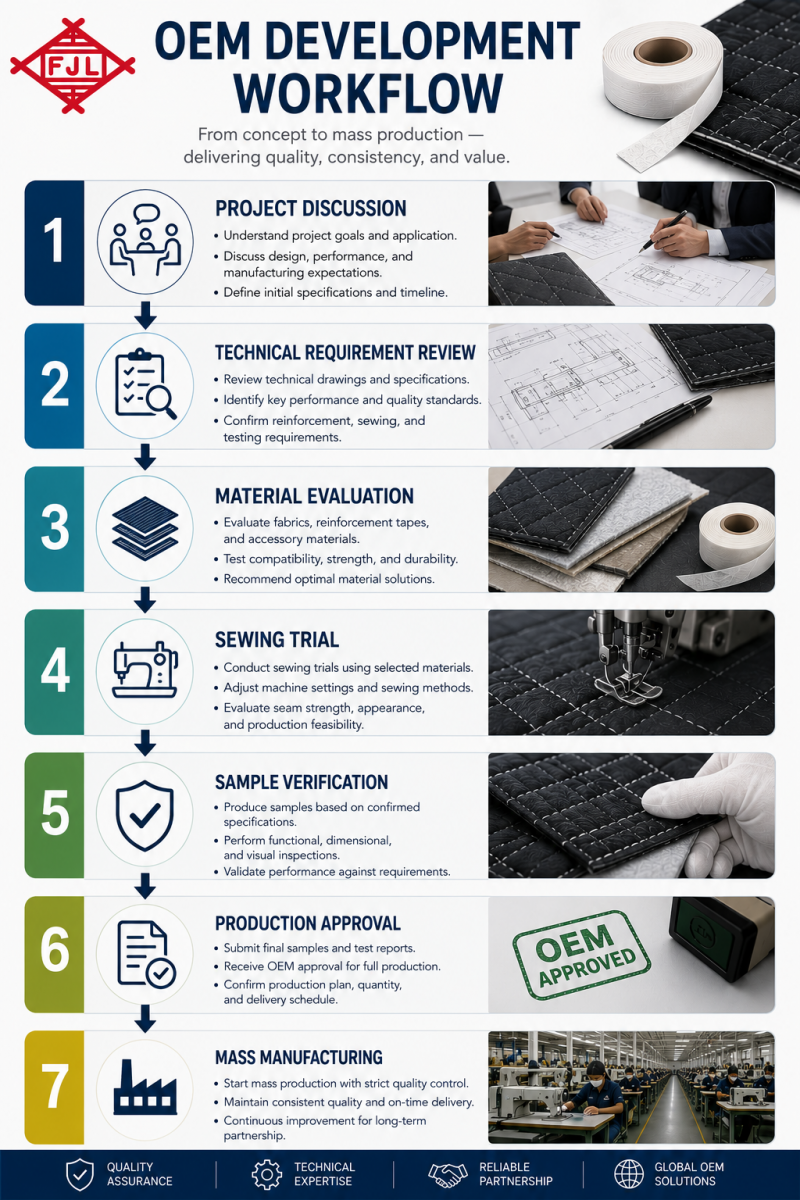
During OEM development projects, engineering teams often conduct multiple sewing evaluations before finalizing production specifications. These evaluations may include seam appearance, dimensional stability, material compatibility, production efficiency, and assembly performance under various manufacturing conditions.
As a result, reinforcement materials are frequently assessed within the context of the entire manufacturing process rather than as individual components.
Early technical discussions between buyers, product developers, and manufacturers help identify reinforcement solutions that match project requirements before production begins. This collaborative approach reduces development risks while improving confidence during prototype approval and subsequent mass production.
For procurement teams, selecting a supplier capable of supporting these technical discussions often provides greater long-term value than evaluating products solely on unit price.
Manufacturing Insight
Manufacturers increasingly evaluate reinforcement materials based on their contribution to sewing consistency, production efficiency, and repeatable manufacturing performance rather than on material cost alone.
Applications Across the Automotive Textile Supply Chain
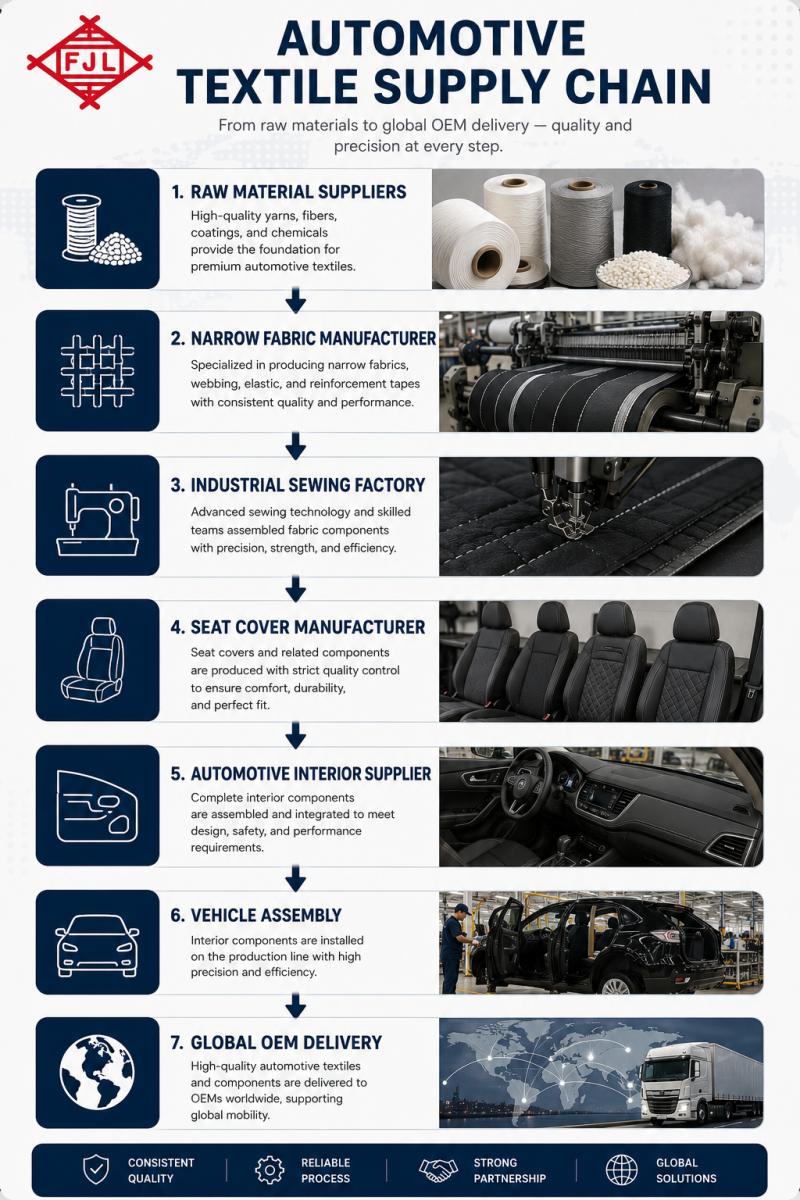
Automotive textile manufacturing extends far beyond vehicle assembly. Every interior component passes through a specialized supply chain involving textile manufacturers, reinforcement suppliers, industrial sewing factories, component assemblers, and OEM production partners. Throughout this process, reinforcement materials contribute to manufacturing stability by supporting consistent sewing performance across different textile constructions and production environments.
For this reason, Woolly Nylon Spin Tape is not limited to a single application. It is increasingly considered during product development wherever textile assemblies require reliable reinforcement while maintaining flexibility and efficient sewing performance.
Rather than serving one specific industry, it supports manufacturers throughout the broader automotive textile ecosystem.
Automotive Seat Manufacturers
Seat systems represent one of the most technically demanding textile applications within the automotive industry.
Modern seat covers typically combine decorative fabrics, laminated foam, backing materials, and multiple reinforcement components. These layered constructions must maintain accurate dimensions during sewing while meeting demanding appearance and durability requirements.
During mass production, consistent seam formation is critical for ensuring that seat covers fit precisely during final vehicle assembly. Reinforcement materials therefore contribute to production stability by helping maintain sewing consistency throughout large production volumes.
For seat manufacturers, the objective is not simply stronger seams—it is achieving repeatable manufacturing quality across every production batch.
Automotive Interior Suppliers
Interior suppliers manufacture a wide range of textile components, including door trim panels, armrests, center console covers, pillar trims, roof liners, storage compartments, and other upholstered assemblies.
These products often combine multiple materials with different characteristics. Maintaining stable sewing performance across varying constructions becomes increasingly important as manufacturers seek to improve production efficiency while reducing quality variation.
Selecting suitable reinforcement materials early during product development allows engineering teams to validate sewing compatibility before production begins, helping reduce unnecessary adjustments during mass manufacturing.
Automotive Trim Suppliers
Automotive trim manufacturers frequently produce components requiring decorative stitching, curved seams, or complex assembly methods.
In these applications, reinforcement materials help support manufacturing stability while allowing production teams to maintain consistent stitch quality throughout different product designs.
Because trim components contribute directly to perceived vehicle quality, manufacturers generally prioritize production repeatability and dimensional consistency over short-term material savings.
Industrial Sewing Factories
Industrial sewing factories often manage production for multiple customers across automotive, technical textiles, transportation equipment, outdoor products, furniture, and protective applications.
This diversity requires reinforcement solutions that integrate smoothly into different sewing processes without requiring major production changes.
Manufacturing flexibility has therefore become an important purchasing consideration. Materials capable of supporting various fabric constructions and sewing methods simplify production planning while reducing operational complexity across multiple customer programs.
OEM Textile Manufacturers and Contract Sewing Partners
OEM production environments require close coordination between product development, engineering, procurement, and manufacturing teams.
During new product development, reinforcement materials are evaluated alongside fabrics, sewing threads, foam constructions, and other textile components to verify compatibility before production approval.
This collaborative approach allows manufacturers to identify potential production issues early, improving overall manufacturing reliability while reducing development time.
For OEM suppliers, consistency throughout the complete development process is often more valuable than selecting the lowest-cost reinforcement material.
Buyer Considerations Before Selecting a Reinforcement Solution
Purchasing reinforcement materials involves more than comparing specifications or quotations.
Automotive procurement teams increasingly evaluate suppliers based on their ability to support long-term manufacturing objectives, including production stability, engineering collaboration, quality consistency, and reliable technical communication.
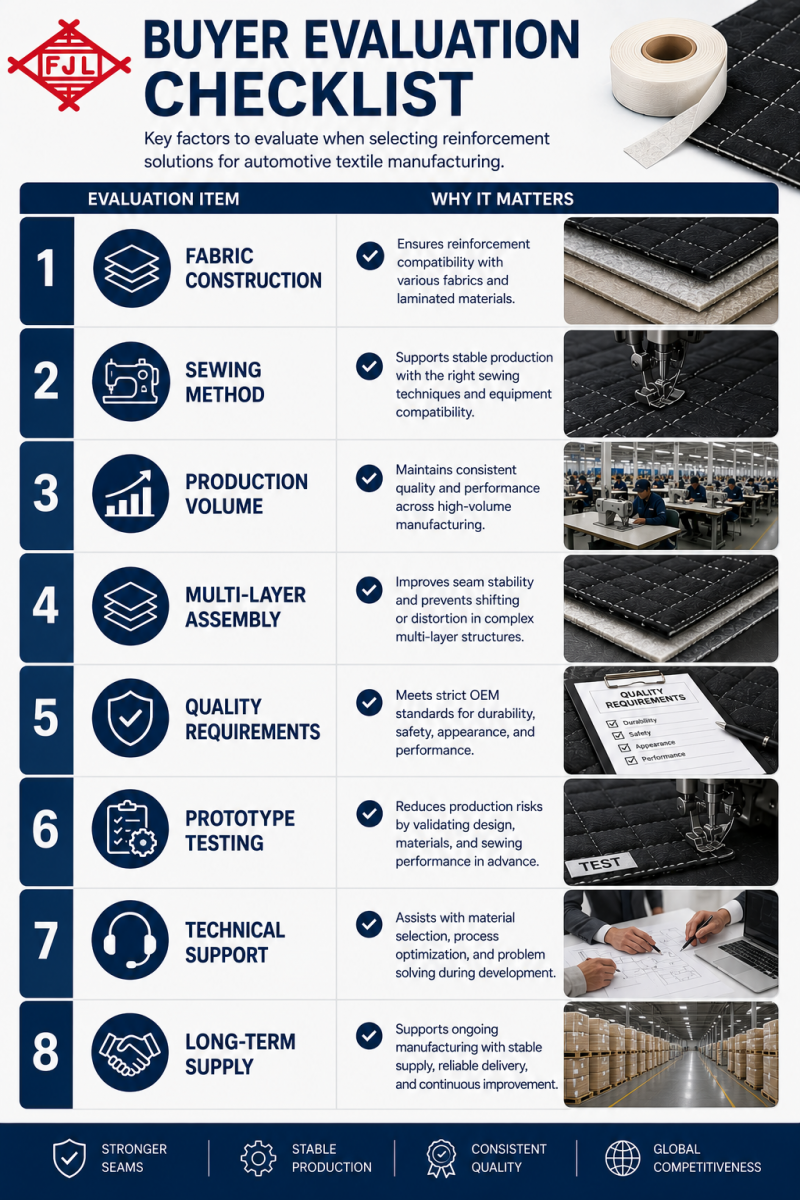
Before selecting a reinforcement solution, buyers commonly review several key manufacturing factors.
Manufacturing Compatibility
Can the reinforcement material perform consistently across different textile constructions and sewing conditions?
Production Consistency
Will sewing performance remain stable throughout continuous production rather than only during prototype trials?
Engineering Support
Can the supplier participate in technical discussions during product development and provide practical recommendations based on manufacturing experience?
Quality Management
Does the manufacturer maintain consistent production standards and quality verification procedures across every order?
Supply Reliability
Can production schedules, repeat orders, and long-term supply requirements be supported without unnecessary disruption?
These considerations help procurement teams reduce manufacturing risks while building more reliable supplier relationships.
Buyer's Insight
Successful procurement focuses on manufacturing reliability, engineering collaboration, and long-term production consistency—not simply on material specifications or purchase price.
Why Long-Term Manufacturing Partnerships Matter
Automotive textile production is rarely based on one-time purchasing decisions.
Vehicle programs often continue for several years, requiring suppliers to maintain stable quality, repeatable manufacturing processes, and consistent communication throughout the entire production lifecycle.
For this reason, many buyers prefer manufacturers capable of supporting product development from initial evaluation through sample verification and ongoing production rather than acting solely as material suppliers.
An experienced narrow fabric manufacturer understands that reinforcement materials influence more than sewing performance—they also affect production efficiency, quality consistency, and long-term manufacturing stability across complex automotive textile projects.
By working closely with engineering teams and procurement departments during the early stages of development, manufacturers can help reduce production uncertainty while improving confidence before full-scale manufacturing begins.
Conclusion
Building More Reliable Automotive Textile Manufacturing Starts with the Right Reinforcement Strategy
As automotive textile manufacturing continues to evolve, manufacturers are expected to deliver higher production consistency, improved sewing quality, and greater operational efficiency while meeting increasingly demanding OEM standards. Reinforcement materials are no longer viewed simply as supporting components—they have become an important part of achieving stable manufacturing performance throughout the entire production process.
For Automotive Seat Manufacturers, Automotive Interior Suppliers, Automotive Trim Suppliers, Seat Cover Manufacturers, and Industrial Sewing Factories, selecting an appropriate reinforcement solution is about more than comparing material specifications. It involves evaluating how a material contributes to sewing stability, multi-layer compatibility, production repeatability, and long-term manufacturing reliability.
Woolly Nylon Spin Tape has become a preferred reinforcement solution for many manufacturers because it supports these production objectives while integrating efficiently into modern industrial sewing environments. When combined with early engineering evaluation, prototype verification, and consistent quality management, the right reinforcement strategy can help reduce production risks and improve overall manufacturing performance.
Related Resources
To better evaluate reinforcement solutions for your next project, you may also find these resources helpful:
-
Woolly Nylon Spin Tape Product Page – Product overview, available constructions, and manufacturing capabilities.
-
Woolly Nylon Spin Tape Specifications – Technical information, available options, and customization details.
-
Woolly Nylon Spin Tape RFQ Preparation Guide – Learn how to prepare accurate project information for faster technical evaluation and quotation.
Whether you are developing automotive seating systems, interior trim components, or other industrial textile products, reviewing these resources can help simplify supplier evaluation and improve communication during product development.
Final Thoughts
Successful automotive textile manufacturing depends on more than selecting quality materials. It requires collaboration between engineering teams, procurement professionals, and manufacturing partners who understand the demands of modern industrial sewing and OEM production.
By choosing reinforcement solutions based on manufacturing performance rather than material specifications alone, buyers can improve production consistency, reduce unnecessary manufacturing risks, and establish more reliable long-term supply partnerships.
|